Introduction
Marketing decisions based on assumptions can be expensive.
A business may invest heavily in Google Ads, social media, SEO, email marketing, or content without knowing which channels are actually generating leads, sales, or long-term customers. While experience and creativity still matter, relying on guesswork alone makes it difficult to understand what is working and where marketing dollars are being wasted.
That is where a data-driven marketing strategy comes in.
Instead of asking, “What do we think our customers want?” businesses can use real data to understand how people discover their brand, what they interact with, which campaigns generate results, and what influences their purchasing decisions.
This approach is becoming increasingly important in Canada as the digital advertising market continues to expand. IAB Canada reports that Canada’s digital advertising market reached $21.1 billion in 2025, growing 16% year over year. Search remained the largest category, while social media continued to be the second-largest.
For businesses competing in this increasingly measurable digital environment, having access to data is not enough. The real advantage comes from knowing how to use it, which is why more companies are now turning to the digital marketing agency North Vancouver businesses trust to make sense of that data.
What Is a Data-Driven Marketing Strategy?
A data-driven marketing strategy uses customer, website, advertising, sales, and campaign data to guide marketing decisions, the same foundation we build for every business that comes to us for digital marketing services North Vancouver companies can measure real results from.
Instead of choosing strategies based purely on assumptions, businesses collect and analyse information to answer questions such as:
- Where are our customers discovering us?
- Which marketing channels generate the most leads?
- Which campaigns produce actual sales?
- What pages do visitors interact with most?
- Where are potential customers leaving the website?
- Which audiences are most likely to convert?
- How much does it cost to acquire a customer?
- Which marketing activities deserve more investment?
The goal is not to collect as much data as possible.
The goal is to collect useful data and turn it into better decisions.
- Make Better Marketing Decisions
One of the biggest advantages of data-driven marketing is that it replaces assumptions with evidence.
For example, a business may believe that social media is its strongest source of customers because its posts receive plenty of engagement.
However, its analytics might show that most qualified leads actually come from organic search.
Without the data, the business could continue investing heavily in the wrong area.
With data, marketing decisions can be based on actual customer behaviour and business results, which is the same approach an online marketing agency North Vancouver business partners with should apply before shifting any budget.
- Understand Your Customers Better
Data can reveal much more than how many people visit your website.
It can help businesses understand:
- What customers are searching for
- What products or services receive the most attention
- What content attracts visitors
- Which offers generate responses
- How visitors move through a website
- What devices customers use
- Where potential customers drop off
- Which audiences are most engaged
These insights help businesses create marketing that is more relevant to the people they actually want to reach.
Instead of creating content for a broad audience and hoping it works, businesses can use customer behaviour to make more informed decisions.
- Get More From Your Marketing Budget
Marketing budgets are rarely unlimited.
Whether a business has a small monthly advertising budget or a substantial multi-channel investment, every dollar should work toward a measurable objective.
Data helps identify which activities are contributing to business growth.
For example, a business might compare:
| Marketing Channel | Leads | Cost Per Lead | Sales |
| SEO | 85 | $32 | 21 |
| Google Ads | 110 | $45 | 28 |
| Social Media | 70 | $38 | 12 |
| Email Marketing | 45 | $18 | 16 |
Looking only at the number of leads could make Google Ads appear to be the obvious winner.
Looking at the entire picture may reveal that email marketing generates fewer leads but produces them at a significantly lower cost and with a strong conversion rate.
That is the value of measuring performance beyond surface-level numbers, which is exactly why an internet marketing company North Vancouver businesses hire will compare cost per lead across channels rather than looking at lead volume alone.
- Measure What Actually Drives Revenue
Likes, impressions, clicks, and website traffic can all provide useful information.
But they are not necessarily business outcomes.
A strong data-driven strategy connects marketing activity to meaningful results such as:
- Qualified leads
- Sales
- Revenue
- Customer acquisition cost
- Conversion rate
- Return on ad spend
- Customer lifetime value
- Repeat purchases
- Cost per acquisition
This helps business owners understand whether marketing is contributing to the bottom line rather than simply generating activity, which is exactly the distinction a marketing agency North Vancouver business owners hire should be making in every performance report.
- Improve Your Website Using Real User Behaviour
Your website can generate valuable marketing data every day.
Analytics can help reveal:
- Which pages receive the most traffic
- Which pages generate leads
- How long visitors engage with content
- Where visitors leave
- Which calls to action receive attention
- Which traffic sources convert best
- What devices visitors use
Suppose a service page receives thousands of visits but generates very few enquiries.
That is an opportunity for investigation.
The problem could be the page content, offer, pricing information, call to action, page speed, design, or overall user experience.
Instead of redesigning the entire website based on opinion, businesses can use behavioural data to identify where improvements are most needed — the same data-first approach local SEO services North Vancouver businesses use to prioritize which pages to fix first.
- Improve Your SEO Strategy
SEO becomes significantly more effective when it is supported by data.
Rather than creating content simply because a keyword appears popular, businesses can analyse:
- Search queries
- Organic traffic
- Search impressions
- Click-through rates
- Ranking performance
- Landing-page performance
- Conversions from organic traffic
- Content engagement
This helps identify which topics deserve more attention and which pages need improvement — the kind of analysis any SEO agency North Vancouver business works with should be running on a regular basis.
For example, if a page receives strong search visibility but very few clicks, its title or search appearance may need attention.
If it receives traffic but generates no enquiries, the issue may be further down the customer journey.
Data helps businesses distinguish between these situations, which is why SEO services North Vancouver companies provide almost always start with a full analytics review before touching a single page.
- Make Google Ads More Efficient
Paid advertising can produce fast results, but spending money does not automatically produce profitable results.
A data-driven Google Ads strategy continuously evaluates campaign performance.
Businesses can monitor:
- Cost per click
- Click-through rate
- Conversion rate
- Cost per conversion
- Search terms
- Audience performance
- Ad performance
- Landing-page performance
- Return on ad spend
These insights make it possible to reduce wasted spending and increase investment in campaigns that are producing meaningful results.
Google itself continues to develop cross-channel measurement tools designed to help advertisers make better budget decisions and understand performance across marketing channels.
- Identify Your Best-Performing Customers
Not every customer has the same value to a business.
Some customers may make one small purchase.
Others may return repeatedly, purchase higher-value services, or recommend the business to others.
Data can help identify patterns among your most valuable customers.
You can examine factors such as:
- Products or services purchased
- Purchase frequency
- Average order value
- Acquisition source
- Customer retention
- Repeat purchases
- Engagement behaviour
Understanding these patterns can help businesses focus marketing efforts on audiences with stronger long-term potential.
- Personalize the Customer Experience
Customers increasingly expect businesses to understand their needs.
Data can help businesses provide more relevant experiences across websites, email campaigns, advertising, and other marketing channels.
For example, a business can use customer behaviour to determine:
- Which products someone viewed
- Which content they interacted with
- Whether they are a new or returning visitor
- What services they previously purchased
- Which communications they engage with
Used responsibly, these insights can make marketing more relevant rather than treating every customer exactly the same.
- Understand the Customer Journey
Customers rarely move directly from seeing an advertisement to making a purchase.
A typical journey might look like:
Search → Website Visit → Content → Retargeting → Enquiry → Sales Conversation → Purchase
Data helps businesses understand what happens at each stage.
This matters because a marketing channel that does not generate the final sale directly may still play an important role earlier in the journey.
For example, social media may introduce someone to a brand, while organic search may bring them back later when they are ready to make an enquiry.
Looking at the entire customer journey provides a more accurate picture of marketing performance.
- Find Where Potential Customers Drop Off
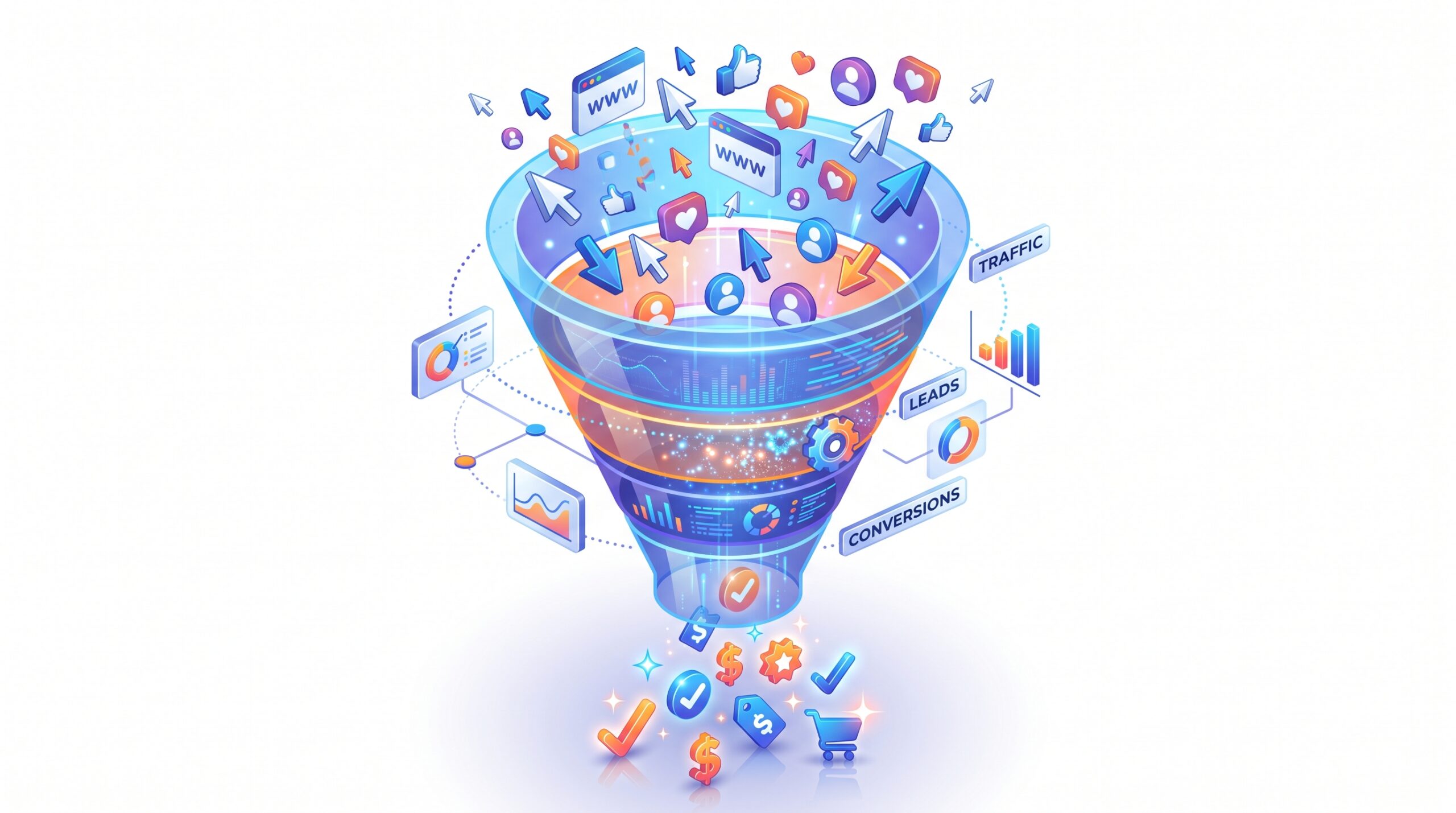
Every stage of the marketing funnel can lose potential customers.
Visitors may:
- Leave the website
- Abandon a form
- Stop engaging with content
- Click an advertisement but not convert
- Start a checkout process and leave
- Submit an enquiry but never complete the sales process
Data can help identify these drop-off points.
Once businesses know where potential customers are leaving, they can test improvements instead of guessing what might be wrong.
- Test Before Making Major Changes
A data-driven strategy encourages businesses to test ideas.
Rather than completely changing a landing page, advertisement, email, or offer based on an opinion, businesses can test different versions and compare their results.
For example:
Version A: “Request a Free Consultation”
Version B: “Talk to a Marketing Expert”
If Version B generates more qualified enquiries, the business has evidence to support the change.
This approach can be applied to:
- Headlines
- Calls to action
- Ad copy
- Landing pages
- Email subject lines
- Offers
- Creative formats
- Website layouts
Small improvements can become significant when applied consistently.
- Respond Faster to Changing Market Conditions
Customer behaviour does not remain constant.
Economic conditions, competition, technology, consumer preferences, and seasonal demand can all influence purchasing decisions.
A data-driven business can identify changes earlier.
For example, a sudden decline in searches for one service alongside increased interest in another could indicate a change in demand.
Instead of waiting until sales decline significantly, businesses can use performance data to identify trends and adjust their marketing accordingly.
- Make Social Media More Strategic
Social media generates a large amount of measurable information.
Businesses can track:
- Reach
- Engagement
- Video views
- Website traffic
- Leads
- Audience demographics
- Content performance
- Conversion activity
This allows businesses to identify what their audience actually responds to.
A post with fewer likes may still be more valuable if it generates several qualified enquiries.
That is why social media performance should not be evaluated solely by engagement numbers.
- Connect Marketing Data With Sales Data
Marketing should not operate separately from sales.
A campaign may generate hundreds of leads, but if most are unqualified, the campaign may not be delivering the expected business value.
Connecting marketing and sales data can help answer questions such as:
- Which campaigns generate qualified leads?
- Which sources produce customers?
- Which leads have the highest value?
- How long does it take to convert a lead?
- Which campaigns generate revenue?
This creates a clearer connection between marketing activity and actual business growth.
- Build a Stronger Content Strategy
Content should solve customer problems—not simply fill a company blog or social media calendar.
Data can help businesses identify what their audience wants to know.
Useful signals include:
- Search queries
- Frequently visited pages
- Popular blog topics
- Customer questions
- Social media engagement
- Website searches
- Content conversions
If customers repeatedly ask the same question, that question could become a blog post, video, guide, FAQ, or social media topic.
The result is content based on actual customer needs rather than assumptions.
- Create a Marketing Dashboard
Businesses do not need to analyse dozens of reports every morning.
A simple marketing dashboard can bring the most important information together.
Depending on the business, it may include:
| Metric | What It Tells You |
| Website Traffic | How many people are reaching your website |
| Leads | How many potential customers you generate |
| Conversion Rate | How effectively traffic becomes leads or sales |
| Cost Per Lead | How efficiently you generate leads |
| Customer Acquisition Cost | What it costs to acquire a customer |
| Revenue | How much business marketing contributes |
| ROAS | Revenue generated from advertising spend |
| Organic Traffic | Performance of SEO and search visibility |
| Engagement | How audiences interact with content |
The goal is to focus on metrics that support decisions—not create reports simply for the sake of reporting.
- Use Data Responsibly
Data-driven marketing does not mean collecting everything possible.
Canadian businesses also need to consider privacy, transparency, consent, security, and responsible data handling.
Customers need to know how their information is being used, and businesses should ensure their marketing practices align with applicable privacy requirements.
This is particularly important as the digital advertising industry continues to evolve around privacy, measurement, trust, and consumer control. IAB Canada has identified these areas as important considerations for the next stage of Canada’s digital advertising ecosystem.
Good data practices are not only about compliance.
They also help build customer trust.
- Turn Data Into Action
Collecting data is only the first step.
The real value comes from what a business does with it.
A useful data-driven process looks like this:
Collect → Analyse → Identify → Test → Improve → Measure Again
For example:
- Collect website and campaign data.
- Identify a page with strong traffic but low conversions.
- Investigate possible reasons.
- Test a stronger offer or call to action.
- Measure the results.
- Keep the improvement if performance increases.
- Continue testing and refining.
This creates a continuous improvement cycle rather than a one-time marketing campaign.
- Build a Marketing Strategy Around Business Goals
Data should support business objectives—not exist separately from them.
Before choosing metrics or marketing channels, determine what the business is trying to accomplish.
If the goal is brand awareness:
Focus on reach, impressions, branded searches, and audience growth.
If the goal is lead generation:
Focus on qualified leads, conversion rates, cost per lead, and lead quality.
If the goal is sales:
Focus on revenue, customer acquisition cost, conversion rates, and return on investment.
If the goal is customer retention:
Focus on repeat purchases, customer lifetime value, retention, and engagement.
This keeps marketing measurement connected to the outcomes that matter most, which is a good gut check any SEO consultant North Vancouver business owners hire will run before agreeing on which metrics to report on.
How to Build a Data-Driven Marketing Strategy
Creating a data-driven strategy does not have to be complicated.
Start with these steps:
Step 1: Define Your Business Goals
Decide what marketing needs to accomplish.
Is the priority more leads, more sales, stronger brand awareness, or customer retention?
Step 2: Identify Your Key Metrics
Choose a small number of metrics that directly relate to those goals.
Step 3: Set Up Reliable Tracking
Make sure your website, advertising platforms, analytics tools, forms, and sales systems are tracking relevant actions accurately.
Step 4: Establish a Baseline
Understand your current performance before making major changes.
Step 5: Analyse Customer Behaviour
Look for patterns in traffic, engagement, conversions, and customer acquisition.
Step 6: Test Improvements
Experiment with different campaigns, content, offers, landing pages, and calls to action.
Step 7: Review Performance Regularly
Marketing data should influence ongoing decisions, not just monthly or annual reports.
Step 8: Reallocate Your Budget
Invest more in channels and campaigns that consistently produce valuable results.
Common Data-Driven Marketing Mistakes
Even businesses that track data can make mistakes.
Tracking Too Many Metrics
More data does not automatically mean better decisions. Focus on the metrics that matter to your objectives.
Focusing Only on Vanity Metrics
Likes and impressions can be useful, but they should not replace leads, sales, revenue, and customer acquisition metrics.
Looking at Data in Isolation
One campaign or one month may not tell the whole story. Look for patterns over time.
Ignoring Data Quality
Incorrect tracking can lead to incorrect conclusions. Your measurement setup needs to be reliable.
Collecting Data Without Acting on It
Reports are not the goal. Better decisions are.
Forgetting the Human Side
Data can identify patterns, but customer conversations, feedback, experience, and creativity still matter.
The strongest marketing strategies combine data with human insight.
The Future of Marketing Is More Measurable
Digital marketing continues to become more measurable, but that does not mean businesses need increasingly complicated strategies.
The priority should be building a reliable system that answers three simple questions:
What is happening?
Why is it happening?
What should we do next?
Canada’s digital advertising market continues to grow, while measurement, data collaboration, AI, privacy, and accountability are becoming increasingly important across the industry.
Businesses that develop strong data foundations can make more informed decisions, respond to changes faster, and continuously improve their marketing performance.
Conclusion
A data-driven marketing strategy gives Canadian businesses something every marketing plan needs: a clearer connection between decisions and results.
Instead of guessing which channels work, businesses can measure them.
Instead of assuming what customers want, they can study behaviour.
Instead of continuing to spend money on underperforming campaigns, they can identify opportunities to improve.
And instead of treating marketing as a collection of disconnected activities, they can build a strategy where SEO, paid advertising, social media, content, websites, and sales work together.
At GrowthHawk Digital Marketing, the digital marketing company North Vancouver businesses rely on, we help businesses turn digital marketing data into practical strategies designed around measurable business goals. From SEO and Google Ads to social media, lead generation, and website performance, the right data can help you make smarter marketing decisions and build sustainable growth.
If your current marketing generates plenty of activity but you are not sure what is actually driving results, it may be time to move from guesswork to data-driven growth.
Frequently Asked Questions
- What is data-driven marketing?
Data-driven marketing uses customer and marketing data to guide strategy, campaigns, and business decisions.
- Why is data-driven marketing important?
It helps businesses understand what works, reduce wasted spending, and improve marketing performance — insight that any digital marketing expert North Vancouver business owners consult with can translate into a practical action plan.
- What marketing data should businesses track?
Key data can include website traffic, leads, conversions, customer acquisition cost, sales, and return on investment.
- Can small businesses use data-driven marketing?
Yes. Even small businesses can use website, advertising, social media, and sales data to make better marketing decisions, and a digital marketing consultant North Vancouver companies recommend can help set up that tracking correctly from day one.
- How can GrowthHawk help with data-driven marketing?
GrowthHawk can help businesses track performance, analyse marketing data, and build strategies around measurable growth objectives.